
Products
-
Tungsten needle is widely used in the construction of furnace tooling and parts and as a feedstock for the fabrication of parts for the electronics and semiconductor industries. Surface can be supplied in a shiny or matte; dependent upon thickness and width parameters.
-
Tungsten Wire There is a kind of tungsten wire named Doped Tungsten Wire, also known as 218 tungsten wire or non-sag tungsten wire. It is the forging of tungsten bar, and made of fine wire drawing, mainly used in incandescent, halogen and other electric light sources.
-
Molybdenum target Moly sputtering target Mo Rotatable sputtering targets Tungsten Rotatable sputtering target Moly special targets W-Mo alloy target.
Purity: 99.9%, 99.95%, the shape as plate, foil, sheet, disc, rod, tube, crucible, the size Thickness > 2mm, Width<1800mm, Lenght<2500mm. -
Welcome to send your enquiry or your question to us online or by email.We will answer you immediately or within 24 hours.
-
1.Standard:ASTM F1713 etc
2.High Precision:H9,H8,H7
3.Grades:Ti-13Nb-13Zr
4.High light:exclude of AL or V
5.Of better mechanical property
6.New Beta titanium alloy materials -
A crucible is a container that can withstand very high temperatures and is used for metal, glass, and pigment production as well as a number of modern laboratory processes. While crucibles historically were usually made from clay, they can be made from any material that withstands temperatures high enough to melt or otherwise alter its contents
-
JINXING METAL offers a complete line of sputtering targets ranging from commercial grade to highest purity, zone refined Ultra-Pure grade. These materials can be fabricated to fit all commercially available systems or to specific dimensions required for your particular applications. A number of metallurgical techniques are employed in PVD material fabrication.
-
Yield tensile Strength: >500Mpa
Density: 8.3g/cm3
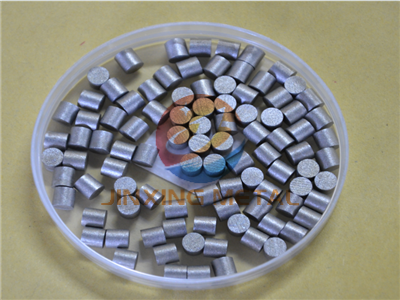
Dia8mm length 15-17mm -
Products Feature:
1. Excellent Conductivity
2. Resistence of high temperature.
3. Abrasion and Erosion.
4. Suitable for making heating wires.
5. Twisted wires for coating films under vacuum and for tungsten wires in electrical light sources usage.Application:
Tungsten is widely used as refractory metals. In wire form, tungsten wire is essential for the production of lighting products and other goods where its high temperature properties are of use. Among its properties are a melting point of 3410° C, a low coefficient of thermal expansion and low vapor pressure at elevated temperatures along with good electrical and thermal conductivity.
The important applications of tungsten wire are for the production of coiled incandescent lamp filaments, cathode and support structures for power tubes, heating elements for high temperature furnaces and evaporation sources in metallizing processes. Thicker sizes of tungsten wire, straightened, finish-ground and cut into rod pieces are widely used for glass-to-metal seal lead parts in the lighting and electronic industries.